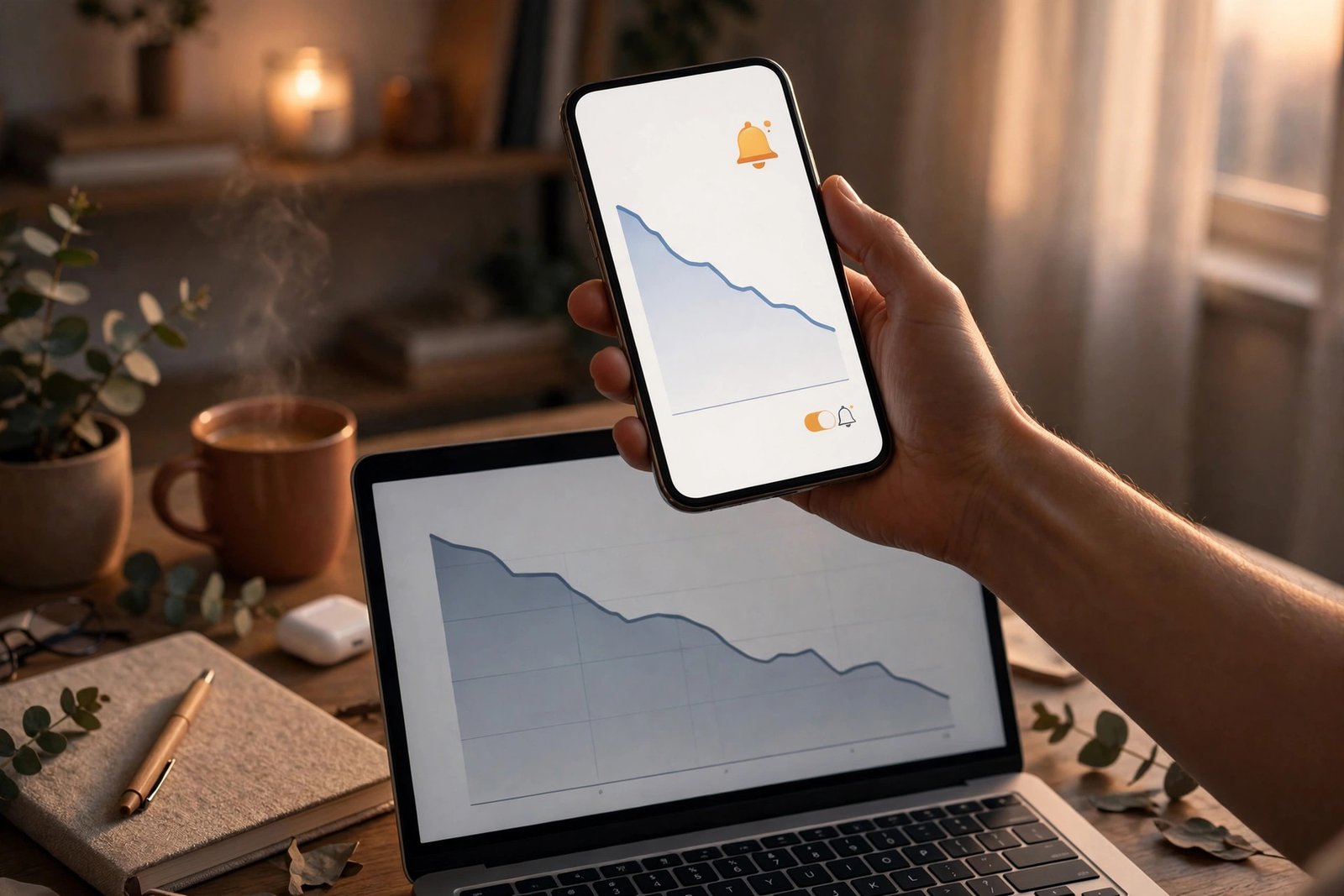
Every Indian sale page shouts the same thing: "₹15,000 OFF!" — off an MRP that nobody has paid in years. The discount percentage is marketing; the only number that matters is what the product actually sold for last month. That is what price tracking gives you: the product's real price history, and an alert the moment the price genuinely drops. This guide covers the tools that work in India, the setup that takes ten minutes, and how to read a price chart so a fake discount can never fool you again.
Start with the habit, not the app. Any purchase above ₹5,000 deserves a two-minute check before you pay: look at the price history, compare the second store, then decide. Everything below exists to make those two minutes easy — and to keep watching prices for you while you do other things.
Key Points
- Keepa is the deepest tracker for Amazon India — price history since 2011, with alerts by email, push or Telegram
- CamelCamelCamel does NOT work for Amazon India — use Keepa or PriceHistory.app instead
- PriceHistory.app and BuyHatke cover Flipkart, Myntra, Ajio and Croma as well as Amazon
- Judge every deal against the 90-day price range on the chart — never against the MRP percentage
- Wishlist before the sale starts, and let alerts — not countdown banners — tell you when to buy
Step 1 — Amazon India: use Keepa. Keepa is the deepest price tracker for Amazon, and it fully supports Amazon India — it has tracked amazon.in prices since 2011. Install the free browser extension and a price chart appears right on the Amazon product page, under the buy box: the product's price line over months or years, the lowest it has ever been, and how today's price compares. Set a target price on anything you are watching and Keepa alerts you by email, push notification or Telegram when the price crosses it. The free tier tracks around 200 products, which is more than most households ever need. Keepa covers Amazon only — it does not track Flipkart, Myntra or Ajio.
One myth to drop first: CamelCamelCamel, the tracker every US guide recommends, does not support Amazon India. Its country list covers the US, UK, Canada, Germany, France, Italy, Spain, Japan and Australia — India is not there. If a guide tells you to track amazon.in prices on CamelCamelCamel, it was not written for India. Use Keepa instead.
Step 2 — Flipkart and the other stores: use PriceHistory.app and BuyHatke. PriceHistory.app is built for Indian stores: paste a product link — or share the product page to the app — from Amazon, Flipkart, Myntra, Ajio, Croma, Tata CLiQ, JioMart or BigBasket, and you get the price-history chart, the lowest price it has ever recorded, and a price-drop alert. It even has a Telegram bot, so alerts can arrive where you already chat. The BuyHatke browser extension and app cover Amazon, Flipkart, Myntra and Ajio with a price-history graph (roughly the last three months), drop alerts, a coupon finder and cross-store price comparison on the product page itself. One caution from experience: extension graphs can lag a day behind a sudden price change, so for a fast-moving sale, confirm on the store page before paying.
Step 3 — wishlist before the sale, not during it. Add everything you are considering to your Amazon and Flipkart wishlists now, while prices are normal. The wishlist becomes your personal baseline: when the sale banners go up, you compare the sale price against the price you saw with your own eyes, not against the MRP the banner invented. During the sale, work from your wishlist and your tracker alerts — never from the sale homepage, which is ordered by what the store wants to sell, not by what is actually cheap.
Step 4 — let Telegram deal channels do the watching. A good deal channel is a human (or a well-run bot) checking prices all day so you don't have to. Ours is Trendstuffs Deals on Telegram: every post is checked against the live store listing before it goes out, and the price in the post is the price you will see when you tap through. Two safety rules for any channel, including ours: the channel never sells anything — you always buy on the store's own page — and if a post shows a screenshot instead of a live link, or the price changes after you tap through, close it and check the price history yourself. Never pay anyone inside Telegram for a product.
How to read a price chart. Three numbers decide whether a drop is real: the 90-day average, the lowest price ever, and today's price. A real drop puts today's price at or below the recent range — ideally near the all-time low. A fake drop looks different: the chart shows the price quietly rising two or three weeks before the sale, then "crashing" back to the normal price under a 40%-off banner. Once you have seen that pre-sale bump on a chart, you will spot it forever. Also read the fine print on the headline price: "from ₹X with bank offer and exchange" assumes a specific card and an old phone to trade in — the price you pay is the one without those conditions.
The MRP trick, specifically. Indian MRPs on electronics are often the launch MRP from a year or two ago. A phone showing "60% off" may simply be sitting at its normal street price after two price cuts nobody announced. This is why the percentage is meaningless and the history is everything: judge every deal by the street-price range on the chart, never by the strike-through. Our own coupon and deal pages follow the same rule — a code is only listed with the price we verified on the store.
Why this matters more in 2026: prices are not only falling. While preparing our laptops under ₹60,000 list, we found gaming laptops that sold for ₹52,000–57,000 in September listing at ₹75,000 and above in November — a "sale" banner on those pages would still leave you paying far more than the September street price. A price history is the only way to know which side of that move you are on. The same check takes thirty seconds on TVs — see our smart TVs under ₹30,000 shortlist for the prices we verified this week.
Your two-minute routine, start to finish: (1) paste the product link into Keepa (Amazon) or PriceHistory.app (any store); (2) check today's price against the 90-day low; (3) check the same product on the other big store; (4) run the product through our coupons page for a code; (5) then buy — or set an alert at the price you actually want and walk away. Walking away is a feature: with an alert set, the deal comes to you.
Set the alerts up this week and they will pay you back immediately: Flipkart's Black Friday Sale is live until 27 November, Black Friday itself is Friday 27 November, and Cyber Monday follows on 30 November. And if you want the bigger map — which months suit which purchases — read our guide to the best time to buy electronics in India next.